How to tailor your dog's diet to their individual needs
Share
Healthy Happy Dog came about because of the research I was doing into Rufus's diet and how I could boost his bowl without having to cook him a homemade meal twice a day. Not that he isn't worth it, but sadly I don't have the time.
That research eventually led to our range of powdered whole-food supplements. At first I was making them for Rufus and sharing them with friends from the dog park. From there, Healthy Happy Dog gradually grew.
One of the things I learned along the way is that there isn't really one perfect diet for every dog. Dogs come in an extraordinary variety of shapes, sizes and breeds, and their needs change according to their age, activity levels, weight and health. What suits a two-year-old Border Collie isn't necessarily going to suit a ten-year-old Labrador.
That doesn't mean we all need to become canine nutritionists or start preparing every meal from scratch. For most dogs, a good-quality complete food provides the foundation. The interesting part is understanding how you can adapt what, and particularly how much, you feed to suit the dog sitting in front of you.
Start with a complete diet
Whatever else you add to your dog's bowl, the starting point should generally be a complete and balanced diet appropriate for their stage of life.
The word complete is important. In the UK, a food described as complete is formulated to provide all the nutrients your dog needs when fed according to the manufacturer's instructions. A complementary food or supplement, including our own blends, is designed to be fed alongside it.
Once you've got that foundation in place, you can start thinking about your dog's individual needs.
Age changes what dogs need
A growing puppy has very different requirements from an adult dog. Puppies need food specifically formulated to support growth and development, and larger breeds can continue growing for considerably longer than smaller dogs.
Once fully grown, dogs generally move onto adult food, but that isn't the end of the story. Their energy requirements can change throughout adulthood and often decline as they get older or become less active.
Senior dogs deserve particular attention. Ageing can bring changes in activity, digestion, muscle mass, joints and appetite. There isn't a magic birthday on which every dog suddenly becomes senior either. A Great Dane reaches later life considerably earlier than a Jack Russell.
Breed and size matter too
A Chihuahua and a Newfoundland are technically eating for the same species, but that's where the similarity ends.
Size affects everything from how quickly dogs grow to how much energy they require. Large and giant breeds need particularly careful feeding while they're growing, while smaller dogs have much smaller stomachs but relatively high energy requirements for their size.
Breed can also influence the health issues worth being aware of. Some breeds are more predisposed to joint problems, others to gaining weight, and some have particular digestive or skin sensitivities. That doesn't mean every Labrador needs one diet and every Dachshund another. Breed gives us useful clues, but the individual dog still matters more.
Look at lifestyle, not just the feeding guide
Two dogs of exactly the same breed, age and weight can have very different energy requirements. A working Spaniel spending hours outside every day is going to burn considerably more energy than one whose principal occupation is moving between the sofa and the sunny patch on the kitchen floor.
Feeding guides on packets are therefore best treated as a starting point. Keep an eye on your dog's body condition and adjust portions accordingly. You should be able to feel their ribs without having to press through a thick layer of fat, and they should have a visible waist when viewed from above.
Treats, chews, table scraps and supplements containing calories count too. It's surprisingly easy for all those little extras to become a significant part of a dog's daily intake.
Their needs won't stay the same
Perhaps the most useful habit is simply paying attention to change. Rufus's requirements today won't necessarily be his requirements in three years' time. A dog that becomes less active may need fewer calories. One that starts accompanying you on longer walks may need more. Neutering can affect energy requirements, while illness or recovery from surgery can change appetite and activity.
Weight is an obvious thing to monitor, but it isn't the only one. Changes in coat, stools, appetite, thirst, energy levels and muscle condition can all tell you something about how your dog is doing. Sudden or unexplained changes should always be discussed with your vet rather than addressed by experimenting with their diet yourself.
Supporting different areas of health
Although all three of our blends are designed to provide broad support for your dog's health, each has particular strengths based on the whole-food ingredients it contains.
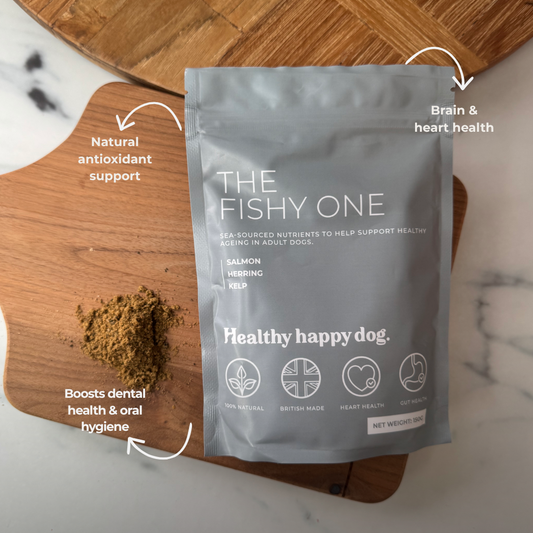
Although all three of our blends are designed to provide broad support for your dog's health, each has particular strengths. The Meaty One has a focus on joints, muscles and mobility; the Veggie One on gut health, brain health and supporting a healthy inflammatory response; and the Fishy One on the heart, brain, joints, skin and coat, as well as healthier teeth and gums.
You can choose whichever blend feels right for your dog, or combine them to offer a broader range of whole-food ingredients.
Think about what you're trying to support
For a healthy adult dog, tailoring doesn't necessarily require changing their main food at all. It can simply mean thinking more carefully about what else goes into the bowl.
That was really the starting point for Healthy Happy Dog.
With Rufus, I wanted the convenience and reassurance of continuing to feed his normal complete food while adding whole-food ingredients associated with different aspects of health. That might mean oily fish for omega-3 fatty acids such as EPA and DHA, pumpkin for fibre, broccoli for beneficial plant compounds or functional mushrooms such as lion's mane and reishi.
That's also why we created three different blends rather than trying to cram everything into one. The Veggie One, Fishy One and Meaty One contain different combinations of whole-food ingredients, and they can be used individually or together depending on what you want to add to your dog's existing diet.
They're still supplements. They aren't there to compensate for a poor diet, treat medical conditions or replace a complete food. They're simply an easy way to put more good stuff into the bowl.
Feed the dog in front of you
There is an enormous amount of advice about what dogs should and shouldn't eat, and it's very easy to disappear down a rabbit hole trying to create the perfect diet.
The biggest lesson I learned from doing exactly that with Rufus was probably a much simpler one. Start with a good complete diet, feed an appropriate amount, keep your dog at a healthy weight and pay attention to how their needs change over time.
Then, if you want to add something extra, think about what you're actually trying to achieve and choose accordingly.
Rufus still doesn't get a freshly cooked homemade dinner twice a day. I'm fairly sure he feels hard done by. But he does get a bowl that's been thought about rather more carefully than it used to be, without me having to spend my evenings cooking for the dog as well as my human pack.